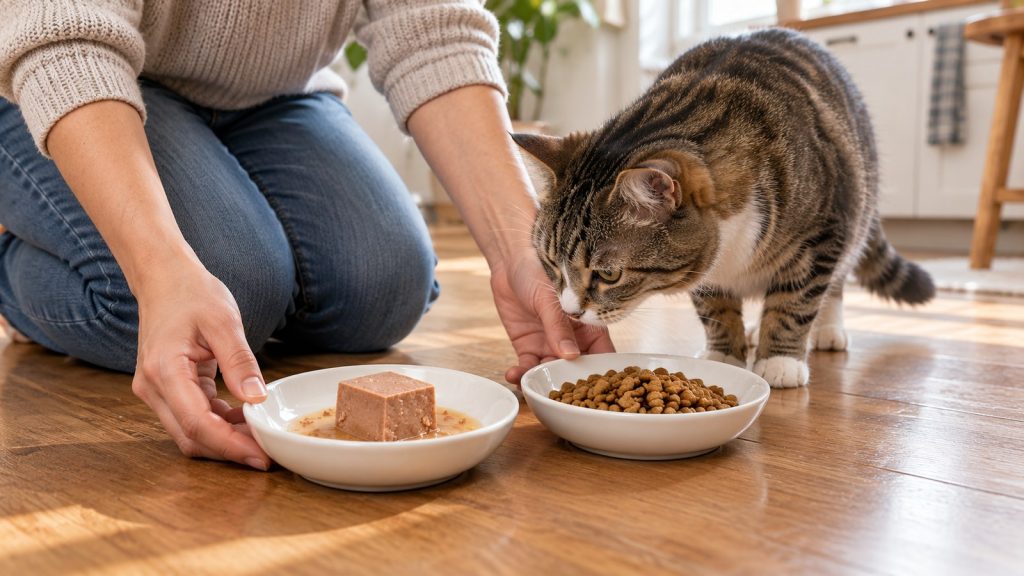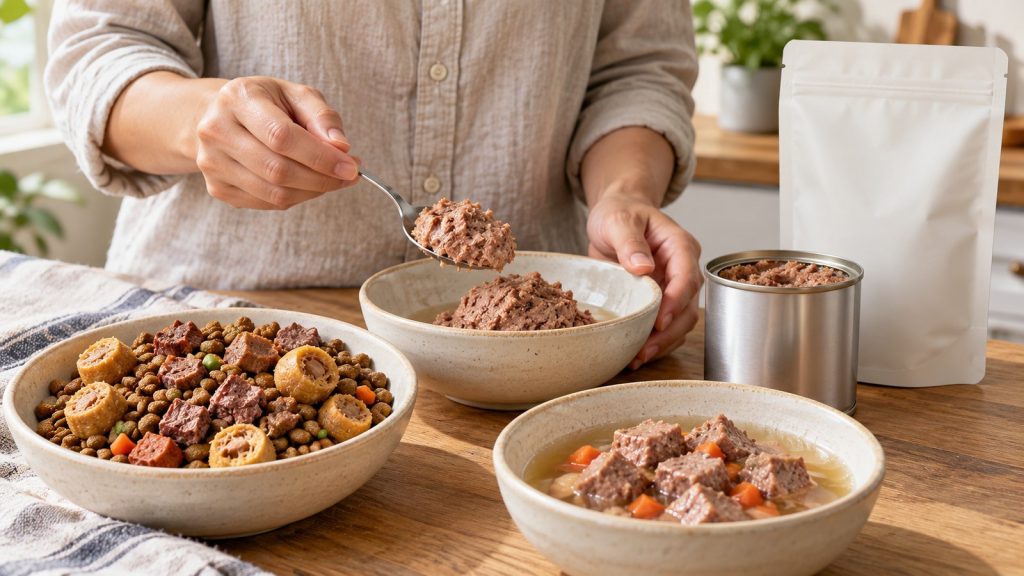

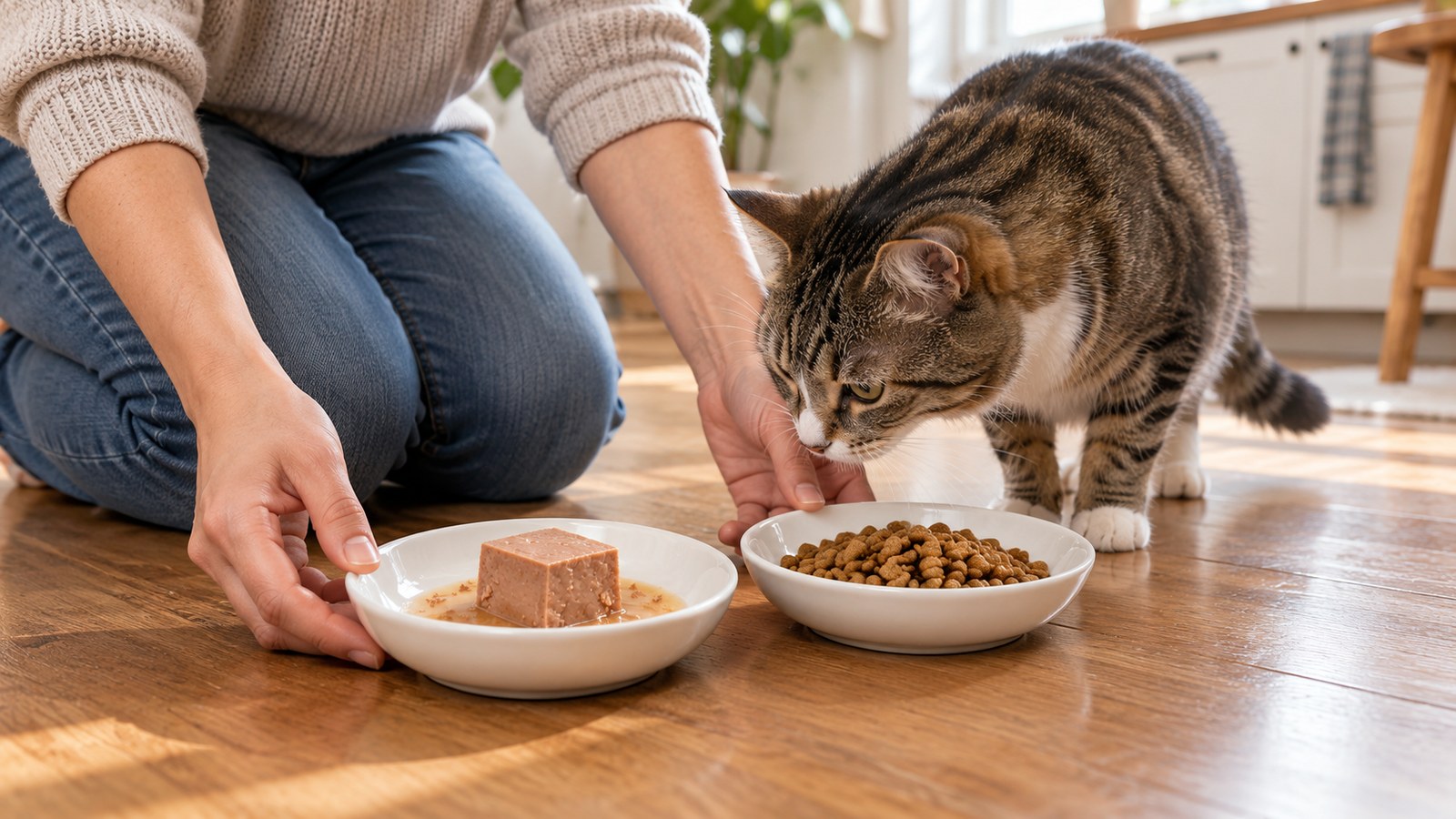
Wet cat food works better when adding water to meals is the priority; dry cat food normally needs no refrigeration and suits automatic or puzzle feeders. Dry food is generally more calorie-dense by weight, while daily feeding cost needs a product-by-product calculation. For brand owners comparing wet vs dry cat food, pairing the formats can serve different needs, provided the feeding directions explain how their portions share one daily calorie allowance.
Wet vs dry cat food: practical tradeoffs
Choose wet cat food when dietary water is the priority; choose dry cat food for automatic or puzzle feeders and storage without refrigeration. Dry food generally supplies more calories per gram, while wet food generally costs more. Mixed feeding requires measured portions within one daily calorie allowance. Exact serving weights depend on actual food calories.
| Comparison | Wet cat food | Dry cat food |
|---|---|---|
| Moisture | More water delivered with each portion | Less dietary water |
| Energy density | Generally fewer calories per gram than dry food | Generally more calories per gram than wet food |
| Meal presentation | Smooth textures, pieces or liquid formats | Dry, bite-sized pieces |
| Portioning | Weigh the serving or use calories per pack | Measure the daily allocation for bowls, automatic feeders or puzzle feeders |
| Opened storage | Refrigerate unused opened canned food; follow product-specific directions | Normally needs no refrigeration; follow product-specific directions |
| Daily cost | Generally higher; calculate from actual price and calories eaten | Generally lower; calculate from actual price and calories eaten |
| Dental positioning | Texture alone doesn’t substantiate a dental claim | A dental claim needs evidence for the specific product and benefit |
For a product range, “wet” is still a broad category. Comparing wet cat food formats helps you distinguish a smooth meal from food containing pieces or a liquid format, rather than treating every wet SKU as interchangeable.
Moisture changes how nutrient labels compare
A lower protein percentage on a wet-food label doesn’t automatically mean the recipe contains less protein relative to its dry matter. The label includes the weight of water, which changes the comparison.
Comparing nutrient percentages on a dry-matter basis accounts for that moisture difference. Formulation still matters: neither format alone establishes which recipe contains more protein on that basis. For product development, compare nutrient profiles on the same dry-matter basis.
Hydration and dental claims need separate checks
Wet food contributes water through the meal; dry food provides less dietary water. For packaging and retailer education, explain dietary moisture without turning it into a promise about kidney, urinary or other health outcomes.
For dental claims, distinguish ordinary kibble from a product tested for a specific dental benefit. Use a claim only when veterinary dental evidence supports that exact product and benefit, and don’t extend it to other crunchy recipes.
Mixed feeding needs one calorie budget
Wet food can be served over dry food as a topper or offered as a separate meal. The portion calculation stays the same: calories from the wet serving replace part of the dry-food allowance.
Use this calculation sequence with actual calorie labels and an already appropriate daily calorie allowance:
- Find each food’s calorie content. Convert values to the same basis, such as kilocalories per gram. Divide kcal/kg by 1,000 to obtain kcal/g.
- Calculate the wet portion’s calories. Multiply the serving weight in grams by its actual kcal/g.
- Calculate the remaining dry portion. Subtract the wet-food calories and any other food calories from the daily allowance, then divide the remainder by the dry food’s actual kcal/g.
Dry portion in grams = remaining daily calories ÷ dry-food kcal/g
These calculations distribute an already appropriate allowance. They don’t establish a feeding target, prescribe a recipe or require a fixed split. Feeding a full daily ration of each would count the allowance twice.
When evaluating a broth format, check its intended use, nutritional classification and calorie content before including it in a portion plan.
Separate meals make each food’s offered portion easier to track. A combined bowl offers another presentation, but owners should still measure both components before serving.
Opened storage changes the convenience comparison
Unused portions of opened canned wet food need refrigeration. Dry food normally doesn’t need refrigeration and can be used in automatic or puzzle feeders. Measure portions and monitor how much is eaten with either format.
For brands, storage instructions belong alongside portion guidance for both wet and dry SKUs. An unopened shelf-life statement doesn’t tell an owner how to handle an opened pack, and pack size affects how much food remains between meals. Make the directions for unused food after opening clear on each pack.
Daily feeding cost beats package-price comparisons
Wet food generally costs more than dry food. Daily feeding cost depends on actual package price, calorie content and how much food is eaten. Package price alone doesn’t give buyers a like-for-like comparison between wet and dry foods.
Use the same already appropriate daily calorie allowance when comparing foods, and calculate each food’s contribution separately:
Daily cost for one food = actual package price ÷ total calories eaten from that package × daily calories eaten from that food
If the full package is eaten, its total calories equal its weight in grams multiplied by its actual kcal/g. If some food is discarded, exclude those uneaten calories from the package total. For mixed feeding, add the costs of the two portions within the single allowance.
This gives distributors and retailers a more useful comparison than price per kilogram alone. It also helps brand owners assess whether a proposed pack size suits the serving pattern: a lower unit price loses value when customers routinely discard part of the contents.
Cat ranges need clear roles for each SKU
At FreshBite, we manufacture dry and wet pet food through OEM, ODM and private label services. A brand can pair products from our dry-food range with wet SKUs, while giving each product a clear feeding role.
For a paired range, define these points before finalizing the packs:
- Whether each SKU is intended as a complete meal or a complementary addition.
- The intended life stage.
- Calories per gram and per serving or pack.
- How the wet serving changes the dry portion.
- Storage directions after opening.
A retailer should be able to explain the pairing without suggesting that every customer needs both formats. Dry-only, wet-only and mixed feeding require suitable food and clear portions; adding another SKU should make the choice easier.
FAQ
Do cats prefer wet food?
Some cats prefer wet food, others prefer dry food, and some accept both. For a range decision, preference for one recipe shouldn’t be treated as proof that cats prefer every product in that format.
Does wet food help with cat constipation?
Wet food contributes dietary water, but constipation needs veterinary assessment rather than a format-based feeding recommendation. A veterinarian should guide food choices for cats with health conditions.
Can kittens follow adult feeding portions?
Kittens have different nutritional needs, so an adult feeding allowance isn’t a kitten feeding plan. Choose food intended for growth or an appropriate all-life-stages diet and use its feeding directions.
Does pâté mean a complete cat meal?
Pâté describes texture, not nutritional adequacy. Check the product’s adequacy statement to establish whether it is a complete food or a complementary product.
Before choosing the wet SKU to accompany a dry range, compare texture as well as feeding role. Our explanation of what pâté cat food is is a useful next read when deciding between pâté, loaf and chunks.